The Hardware Store Is Becoming City Hall. That Tells You Almost Everything About Montgomery.
A former hardware store near Montgomery's historic district is being planned as a municipal complex. Along Highway 105, H-E-B and more development are arriving. The building is not merely changing tenants; it is recording the moment a town changed scale.
A former hardware store near Montgomery's historic district is being planned as a municipal complex. Along Highway 105, H-E-B and more development are arriving. The building is not merely changing tenants; it is recording the moment a town changed scale.
A town does not announce the morning it stops being small. There is no siren. No ribbon is stretched across the old city limit sign. Nobody walks into the coffee shop and says, "Well, that was it. Yesterday we were a town and today we are something else."
The change usually appears in pieces. More brake lights on Highway 105. A pasture becomes survey stakes. A familiar shortcut acquires a turn lane. The grocery trip gets easier, the intersection gets slower, and the people at City Hall discover that a building that once seemed adequate no longer has room for the work arriving at its door.
Then one day the hardware store becomes City Hall.
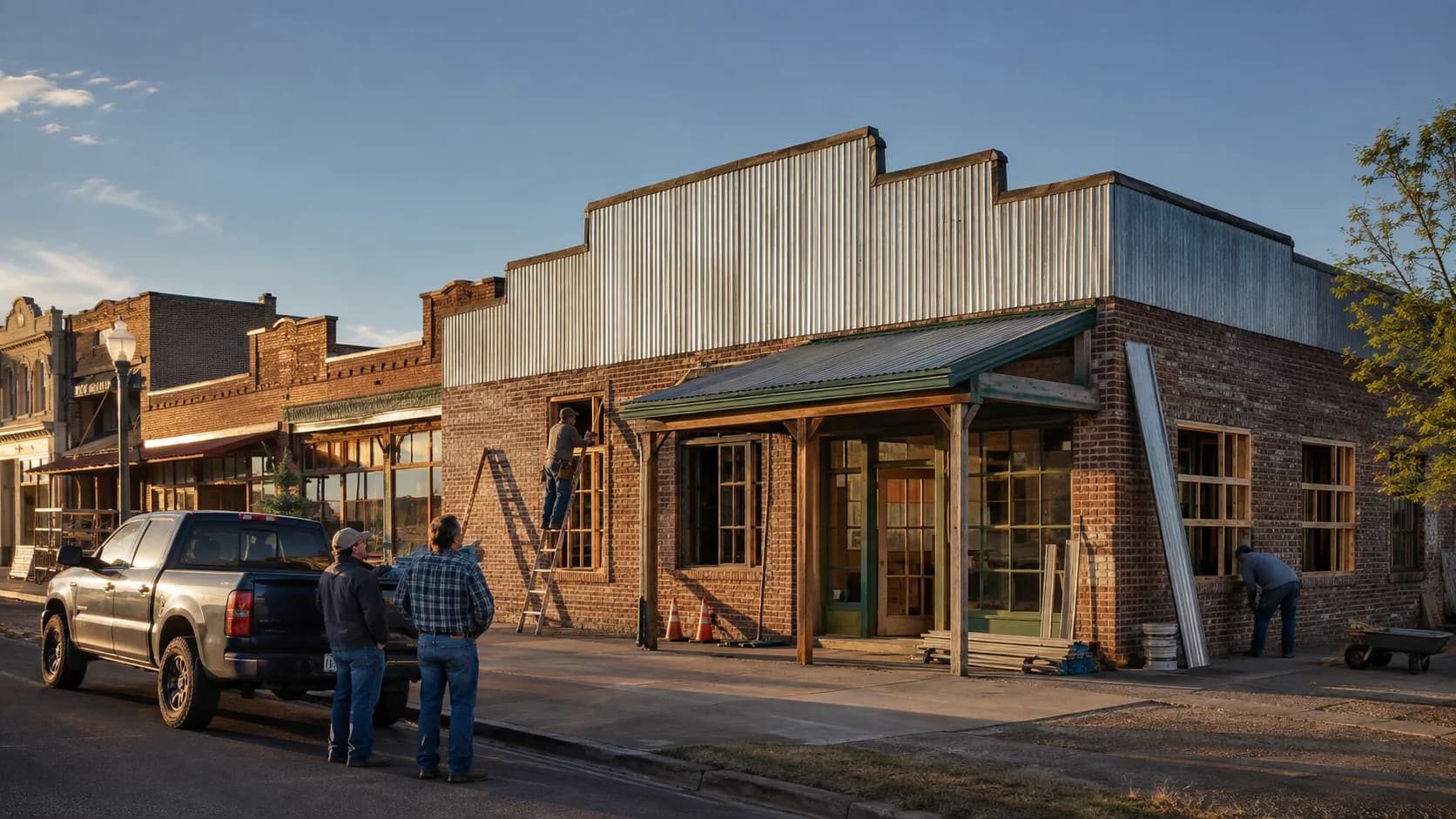
That is what Montgomery is planning for the former Jim's Hardware building near the north end of its historic district. The store that once sold screws, lumber, tools and the small things people needed to keep their property working is being considered for a two-story municipal complex housing city administration and the police department. It would be difficult to invent a better symbol for this moment in Montgomery if somebody tried.
The building that helped people build things

Hardware stores have always been more than shelves. They are places where a person walks in carrying a broken hinge, a corroded fitting or a bolt from a machine nobody manufactures anymore and asks, "Do you have one of these?" In a good hardware store, the answer is often followed by a conversation. Somebody knows what the part is, why it failed and what will happen if you replace it with the wrong thing. The exchange is small, practical and human. The customer brings the problem. The store helps him solve it. Then both go back to living in the same community.
Jim's Hardware operated in Montgomery from 2019 until owner Jim Ward retired and the store closed in the summer of 2025. City officials have said Ward offered Montgomery the first right of refusal on the property, and the city took possession that August. The location mattered. It sits along FM 149 near the historic district, close enough to the older town that Mayor Sara Countryman described the goal as placing city government near Montgomery's "heartbeat."
The building is not merely changing tenants. It is recording a change in scale. Montgomery once needed the hardware store because people were building houses, repairing land and maintaining the physical pieces of daily life. Montgomery now needs more government space because all that building brought permits, records, traffic, utilities, police work, meetings and decisions. The workbench is becoming the council chamber because the town outgrew the room where it had been conducting its business.
City Hall outgrew City Hall
The present City Hall and police department share roughly 6,300 square feet at 101 Old Plantersville Road. The building dates to 2006. Twenty years is not ancient for a municipal building. It is long enough, however, for a fast-growing place to become something its earlier floor plan could not anticipate.
Officials have described the proposed complex as roughly 32,000 to 35,000 square feet, depending on the design stage. Preliminary plans have included a large central council chamber, public-facing city offices, record storage, flexible meeting space and a separate, secure area for police operations. Police Chief Anthony Solomon has said the current building lacks enough room for evidence and for officers to do the work required of them.
That is not decorative growth. A city can ask employees to squeeze desks together. It cannot responsibly treat evidence storage, booking, security and public access as afterthoughts forever.
The project has been discussed at an estimated cost below $10 million. City leaders have said they do not expect to seek a bond. Part of the proposed funding could come from the Montgomery Crime Control and Prevention District, which voters approved in 2024 with a dedicated quarter-cent sales tax while reducing the economic development sales-tax rate by the same amount. The police chief has estimated that approximately $7 million from that district could support the complex, with money from the sale of city-owned property also contributing.
Those details matter because growth sends the bill before it sends the postcard. New rooftops can broaden a tax base. New stores can create jobs and convenience. But a larger population also needs water pressure, sewer capacity, roads, records, officers, inspectors and public rooms large enough for citizens to argue about what happens next. Growth arrives as convenience. It stays as infrastructure.
Moving toward the heartbeat
There is something encouraging in the city's decision to move closer to the historic district instead of farther from it. Municipal buildings can become remote administrative boxes, separated from the daily life they govern by parking lots and wide roads. A City Hall near the center of an old town can work differently. People pass it. They know where it is. Government becomes part of the visible landscape instead of a building visited only when a permit is needed or something has gone wrong.
The proposed design could also preserve a useful piece of property by adapting it rather than abandoning it. A building that served commerce can serve public life. That is not a rejection of history. Reuse can be one of the most honest ways to keep history active.
But proximity alone does not preserve character. A city can place its offices beside the heartbeat and still make decisions that weaken it. The real test will be whether growth beyond downtown directs people toward the historic center or gives them fewer reasons to enter it—whether sidewalks, parking, signs, trees, traffic patterns and public events continue to make the old town feel inhabited rather than displayed. Historic character is not a paint color. It is the relationship between buildings, businesses and people.
Highway 105 is telling the same story louder

The municipal complex may be Montgomery's clearest symbol of change, but Highway 105 is where the change becomes impossible to miss.
A 127,186-square-foot H-E-B is planned at FM 2854 and Highway 105 West. The state construction filing lists the privately funded store at an estimated $30 million, with a projected completion date in late August 2026. Earlier local reporting anticipated an opening later in the year, and plans have included a fuel station, car wash and restaurant drive-through.
For residents, a new H-E-B is not an abstract economic-development statistic. It means groceries closer to home, more jobs and one less reason to make a longer drive. Those are real benefits, especially when a community has grown beyond the services that once met its needs. It also changes the commercial gravity of a place. A store of that size pulls traffic, smaller businesses and additional development toward it.
In 2025, the City Council approved a memorandum describing as much as $4.8 million in reimbursement for public infrastructure tied to a 32.72-acre mixed-use project near Lone Star Parkway and Highway 105, behind Home Depot. The work discussed included water and sewer extensions, road connections and potential landscaping.
None of that is evidence that growth is wrong. It is evidence that growth is a chain reaction. The grocery store needs access. The next development needs utilities. The additional traffic needs a response. The city needs employees and space. Each decision is reasonable when viewed by itself. Together, they can remake a town faster than residents realize the decisions have accumulated.
That is why arguments about growth often become confused. One side is accused of wanting to stop time. The other is accused of wanting to pave everything. Most people live somewhere between those positions. They want the grocery store and the old downtown. They want a police department with proper evidence space and a government that still feels approachable. They want new tax revenue without discovering that the businesses which created the town's character cannot survive the new traffic, rents or competition. Wanting both is not hypocrisy. It is the actual work of planning.
What cannot be rebuilt once it is gone

Montgomery has been a trading place since before Texas was a state. The city's own history traces its beginnings to an 1826 trading post and its charter to 1837. Stagecoach and telegraph lines once crossed there. It served as Montgomery County's first county seat, and the town still identifies itself with the birthplace of the Lone Star Flag.
In other words, change is not new to Montgomery. The community was built by it. That history should keep the conversation honest. The town people remember was not frozen in time. Roads arrived. Businesses changed. County government moved to Conroe. Homes were built, stores closed and new families became old families. The goal cannot be to preserve every building exactly as it was or to make newcomers apologize for arriving. A living town has to change. The question is whether it changes with memory.
Memory asks different questions from nostalgia. Nostalgia asks how to make the present look like the past. Memory asks what made the place worth keeping. Was it the scale of the buildings? The ability to walk from one local business to another? The chance of encountering somebody you knew? The old trees? The view down a street? The patience to adapt an existing structure before replacing it? The feeling that decisions were being made with the town, not simply happening to it?
Those answers can guide practical choices. They can shape zoning, setbacks, signage, landscaping, road design, public spaces and the way a large development meets a small historic district. They can determine whether downtown becomes the heart of a larger Montgomery or a preserved island surrounded by a place that no longer speaks the same language.
A larger City Hall can be built. A lost sense of place is harder to reconstruct.
The hardware store's last lesson
The best hardware stores never promised that nothing would break. They simply kept the parts, knowledge and patience needed to repair what could be saved.
Montgomery might take that lesson with it as Jim's Hardware becomes a municipal complex. The new building can give police officers the secure space they need. It can give city staff room to serve a population the old City Hall was not designed to handle. It can bring government closer to downtown and place the council chamber near the center of the community it represents. Those are worthy things.
But the building will also stand as a reminder. A town is not preserved by refusing every new store, road or neighborhood. It is preserved by knowing which parts are load-bearing before the remodeling begins.
The hardware store is becoming City Hall because Montgomery is growing. What happens inside it will help decide whether Montgomery merely becomes larger—or becomes larger without becoming unrecognizable. The question is not whether Montgomery grows. It is whether Montgomery can still recognize itself when the work is finished.